
Most people book New York to London flights either way too early, hoping to lock in a good fare 10 months out, or way too late, scrambling three weeks before a trip and paying double. The actual sweet spot is narrower and more boring: roughly 60 to 90 days before departure, on a Tuesday or Wednesday flight, in any month except July.
This guide breaks down what the data on transatlantic pricing shows for the New York to London route. The booking window that saves you money. The months you should fly and the months to avoid. The day-of-week patterns that move prices by 15 percent. And the calendar map for when to start watching prices, depending on when you want to fly.
The route itself is one of the most competitive in the world. Five carriers run nonstops from JFK or Newark to Heathrow or Gatwick, and a couple more (Norse, Aer Lingus via Dublin) compete on price. That density is good news. It means there's almost always a cheaper option than the first fare Google Flights shows you, if you know when to look.
The booking window that saves you money
For a New York to London nonstop, the cheapest fares typically appear 60 to 90 days before departure. NerdWallet's analysis of Expedia 2026 data puts the international flight booking window at "two to eight months out," but the practical sweet spot inside that range is the two-to-three-month window. Earlier than that, airlines have just opened inventory and prices are inflated to feel out demand. Later than 21 days, prices spike sharply as remaining inventory tightens.
This is the part most travelers get wrong. There's a popular belief that booking 10 or 11 months ahead locks in the best fare. It doesn't. Airlines load schedules 11 months ahead, but they price those early seats high on purpose, betting that some travelers will pay up for certainty. Real fare drops come during the routine inventory rebalancing that happens 60 to 120 days out. Going's analysis of US-to-London pricing confirms this same 1-to-3 month domestic and 2-to-8 month international window.
The practical workflow: about four months before your trip, set Google Flights price alerts for your dates. Watch the email notifications. Book when you see a sustained drop, usually around the 60-to-90-day mark. If you're more than four months out, you're better off doing nothing.
Cheapest months to fly to London from New York
February is the cheapest month, narrowly. January and February together form the lowest-priced band of the year, with Going's deal data showing February as the month with the most discounted US-to-London fares. Late October through early December is the second-cheapest band, excluding the Thanksgiving travel week.
The cheapest specific weeks tend to fall in mid-January through mid-February (the post-Christmas slump), late February through mid-March (still off-season), and late October through the second week of December (after foliage season, before the Christmas surge).
A round-trip in any of these windows can run 30 to 40 percent less than the same itinerary in July. The trade-off is the weather, which in London ranges from cold-and-grey to cold-and-grey-and-wet during these months. If your trip is event-driven (a wedding, a concert, work) the savings are usually worth it.
Most expensive times to book this route
July is the peak. June and August trail closely. The June-through-August stretch is when school is out in both countries, when British weather is most reliably good, and when American demand for London concentrates around major summer events. Expect to pay 50 to 100 percent more than the off-season for the same routing.
Christmas week, defined as roughly December 18 through January 2, is a separate spike. It's narrower than the summer peak but sharper, especially the December 22-to-26 window. Easter week (movable, but typically late March or April) gets a smaller bump that mostly affects family travelers.
The shoulder months (April, May, September, October) fall in the middle. They're not as cheap as winter but offer the best weather-to-price ratio. A May trip will cost roughly 20 percent more than a February trip, but the chance of usable London weather is much higher.
Which departure days are usually cheaper?
Departure day matters more than booking day. Flying out on a Tuesday or Wednesday consistently beats flying out on a Friday or Sunday. The price gap is real: Expedia's 2026 data shows up to 8 percent savings for shifting a departure off Sunday, and on the New York to London route specifically the gap is closer to 15 percent during peak season.
The booking-day myth, that you should buy on a Tuesday afternoon, has been debunked repeatedly. NerdWallet's own analysis notes that "the day you book matters less than how far in advance you book." If you're optimizing, book on whatever day you spot the price dip. There is no magic Tuesday.
Return-day patterns work the same way. A Wednesday-to-Wednesday or Tuesday-to-Tuesday trip will almost always beat a Friday-to-Sunday trip on this route, because corporate travelers and weekend trippers compete for the same Friday inventory.
Daytime vs overnight flights to London
Most New York to London flights are overnight redeyes, departing 6pm to 10pm Eastern and arriving early morning at Heathrow. There are also five daytime options from JFK or Newark, run by British Airways, Virgin Atlantic, JetBlue, American Airlines, and United. Daytime flights leave around 8am to 9am Eastern and arrive in London in the evening.
The price difference between daytime and overnight is usually small, with daytime flights running 5 to 10 percent more during peak season. The case for paying the premium: daytime flights skip the broken-sleep redeye experience, you sleep in a real bed in your London hotel that night, and the jet lag is significantly easier to recover from. The case against: you lose a workday, and the timing forces an early wake-up at home.
For a short trip (three or four nights), daytime flights are worth the extra cost. For a longer trip, the redeye savings compound and the jet lag is recoverable.
When to start tracking prices by trip type
Working backward from common trip types:
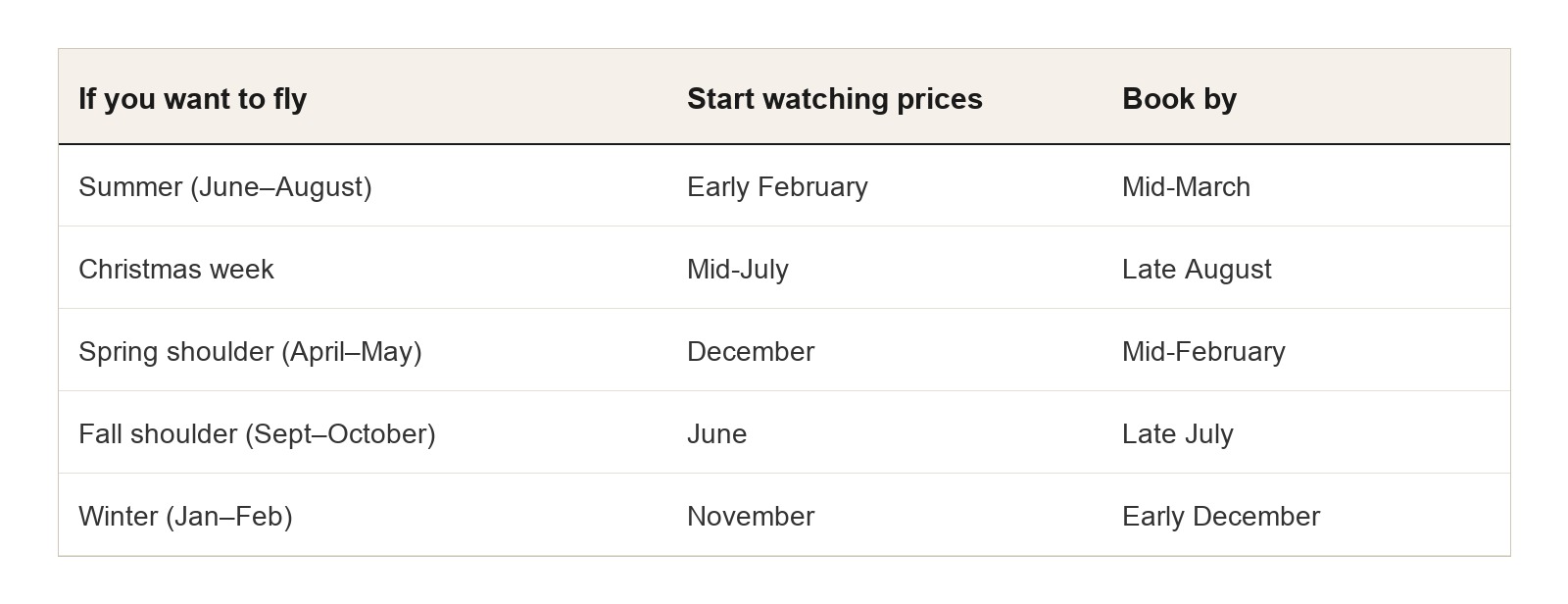
The rule of thumb: subtract 90 days from your departure date and start checking prices 30 days before that. Book when you see a sustained drop or by the 60-day mark, whichever comes first.
If you're booking inside the 30-day window because the trip came up suddenly, ignore most price-tracking advice. Look at flexible-date searches across nearby airports (LGA, EWR, LHR, LGW, STN, LCY), and consider adding a one-stop routing through Dublin or Reykjavik. The savings on a one-stop can be 30 to 50 percent versus a same-day nonstop booking.
How airline pricing works on New York to London flights
Transatlantic pricing on the New York to London route works through fare buckets. Each plane has a fixed number of seats in each fare class, and the airline opens cheaper buckets early to fill the plane, then closes them as the flight gets closer to departure. When the cheap buckets are gone, prices jump.
This means two practical things. First, the same flight can have radically different prices depending on how many seats are left in the cheaper bucket. The price you see is not the cost of running the flight; it's the cost of the next available seat in that fare class. Second, the bucket model rewards flexibility. Searching plus-or-minus three days on Google Flights or Skyscanner will often find a 100-dollar swing for the exact same route, because adjacent days have more bucket inventory left.
The popular advice about booking on a specific day of the week is mostly noise. The bucket model is what matters, and bucket transitions happen continuously, not on a schedule.
Common questions
Frequently asked questions about NYC to London flight pricing.
How far in advance should I book flights from New York to London?
Two to three months ahead, on average. The cheapest fares for transatlantic routes typically appear in the 60-to-90-day window before departure. Earlier than that, prices are artificially high. Later than 21 days, they spike. For peak summer or Christmas dates, push the booking window earlier, to five or six months ahead, because cheaper buckets fill faster.
What months are busiest for New York to London flights?
July, June, and August, in roughly that order. The summer peak runs from school's-out in late June through Labor Day in early September. December has a separate, narrower spike around Christmas week.
When is demand highest for flights to London from New York?
Mid-July through mid-August is the highest-demand window of the year. Christmas week (December 22 through January 1) is the second-highest. Easter week and the week of the London Marathon (late April) cause smaller demand bumps.
Do flight prices change depending on the season?
Yes, by roughly 50 to 100 percent between the cheapest and most expensive months. February and November are the cheapest. July is the most expensive. Shoulder months (April, May, September, October) fall in between and offer the best weather-to-price ratio.
When do most people book flights from New York to London?
Most New York to London bookings happen 30 to 60 days before departure, which is later than the optimal 60-to-90-day sweet spot. The result is that average fares are higher than they need to be. Most travelers leave money on the table by booking inside the 60-day window when prices are already rising.
Book your London hotel through Dyme
We don't sell flights, but we do book the hotel for the rest of your trip. Every hotel booking on Dyme funds solar installations for schools and hospitals, cutting their electricity costs for decades. Whether you're flying in for a long weekend or a two-week stay, Dyme has options across central London at competitive rates.
Frequently asked questions
Which departure days are usually cheaper?+
Departure day matters more than booking day. Flying out on a Tuesday or Wednesday consistently beats flying out on a Friday or Sunday. The price gap is real: Expedia's 2026 data shows up to 8 percent savings for shifting a departure off Sunday, and on the New York to London route specifically the gap is closer to 15 percent during peak season.The booking-day myth, that you should buy on a Tuesday afternoon, has been debunked repeatedly. NerdWallet's own analysis notes that "the day you book matters less than how far in advance you book." If you're optimizing, book on whatever day you spot the
How far in advance should I book flights from New York to London?+
Two to three months ahead, on average. The cheapest fares for transatlantic routes typically appear in the 60-to-90-day window before departure. Earlier than that, prices are artificially high. Later than 21 days, they spike. For peak summer or Christmas dates, push the booking window earlier, to five or six months ahead, because cheaper buckets fill faster.
What months are busiest for New York to London flights?+
July, June, and August, in roughly that order. The summer peak runs from school's-out in late June through Labor Day in early September. December has a separate, narrower spike around Christmas week.
When is demand highest for flights to London from New York?+
Mid-July through mid-August is the highest-demand window of the year. Christmas week (December 22 through January 1) is the second-highest. Easter week and the week of the London Marathon (late April) cause smaller demand bumps.
Do flight prices change depending on the season?+
Yes, by roughly 50 to 100 percent between the cheapest and most expensive months. February and November are the cheapest. July is the most expensive. Shoulder months (April, May, September, October) fall in between and offer the best weather-to-price ratio.
When do most people book flights from New York to London?+
Most New York to London bookings happen 30 to 60 days before departure, which is later than the optimal 60-to-90-day sweet spot. The result is that average fares are higher than they need to be. Most travelers leave money on the table by booking inside the 60-day window when prices are already rising.