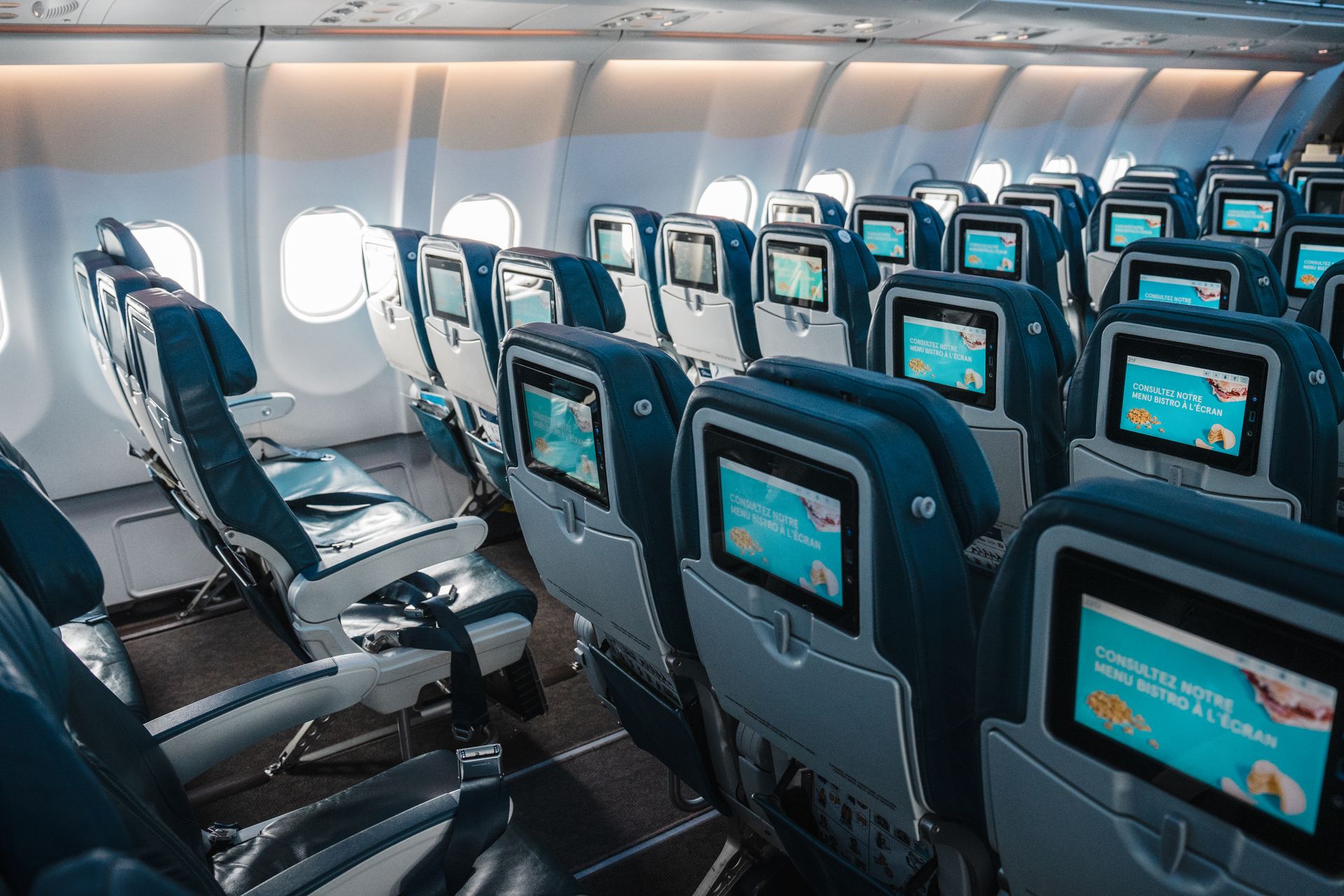
A business-class seat on a wide-body counts as four economy passengers. First counts as five. Those are not our numbers. They are the multipliers written into the standard behind most of the per-passenger figures you already see, and they mean the biggest lever in your air program is your cabin policy rather than which carriers are on your preferred list.
That is inconvenient, because the cabin policy is the part nobody wants to reopen and the carrier list is the part that comes up at renewal anyway. The cabin policy is still where the tonnes are.
Below is what a sustainability criterion in an airline RFP can be held to, taken from the standard and the regulation rather than from carrier marketing.
IATA RP 1726: the standard behind your numbers
Start with the document: IATA Recommended Practice 1726, the passenger CO2 calculation methodology adopted by IATA's Passenger Service Conference in March 2022. It is what IATA's CO2 Connect implements, and it is a public PDF.
The calculation runs on recorded fuel burn per flight, aircraft-type specific, leg by leg on the booked origin and destination. IATA recommends aligning the fuel-monitoring boundary with what carriers already do for CORSIA reporting under Annex 16, Volume IV of the Chicago Convention. Fuel converts to CO2 at 3.16 kg of CO2 per kg of fuel.
Read it before your next carrier conversation. Several of the arguments you are about to have are already settled in it.
The cabin multipliers, which decide more than the carrier does
Section 2.4.2 sets the factors. Section 2.4.1 gives the reason: "the different weight and space associated with a passenger seat in different cabin classes."
| Aircraft | Economy | Premium economy | Business | First |
|---|---|---|---|---|
| Narrow-body | 1 | 1 | 1.5* | 1.5 |
| Wide-body | 1 | 1.5 | 4 | 5 |
IATA RP 1726, section 2.4.2. *A narrow-body whose seating is offered entirely as business class takes 4 instead of 1.5, per the footnote to that table. Section 2.4.2.1 lets a carrier substitute its own factors where its cabin differs from the standard, so two airlines' figures are not automatically comparable.
Look at the wide-body row. Moving one transatlantic traveler from business to premium economy takes that trip from four units to 1.5. Cabin and routing are the levers your program controls, and this is why.
It also suggests a running order. Settle the cabin threshold and the routing rules first, then choose carriers, then write the sustainability language. Do it the other way round and the sustainability clause ends up doing the job the cabin policy should have done.
Three things the standard will not let you subtract
Three rules in the same document. The first tells you the number is smaller than it looks; the other two close off subtractions a supplier may offer you.
Upstream emissions are out. Section 1.4: "The upstream CO2 emissions are not included." So an RP 1726 figure is combustion only, not well-to-wake. If you are reconciling it into a Scope 3 inventory, you are missing a layer, and that belongs in your methodology note rather than in a footnote nobody reads.
Buying SAF does not lower your trip numbers. Section 2.5.1 says lifecycle emissions relating to sustainable aviation fuel claimed by "passengers or third parties (e.g., corporate businesses or cargo customers) cannot be claimed or reduced as part of the CO2 calculation for attribution to general passengers," and names the reason: Greenhouse Gas Protocol protections against double counting.
A corporate SAF purchase is a real thing that gets accounted separately. A supplier showing you a reduced per-trip figure because of it has departed from the standard, and that is worth catching in evaluation rather than in your first annual report.
Nor do the airline's own offsets. Section 2.6.2: "Member invested carbon offsets shall not be used as part of this methodology to reduce the per passenger CO2 calculated result(s)." The results, it adds, "are a representation of the real CO2 emissions values."
The standard also concedes its own unfinished edge. Section 2.5.2 says the exact SAF accounting rules "will have to be determined as part of the global SAF book and claim system." Anyone selling you certainty on that today is ahead of the document.
What ReFuelEU Aviation does, and does not do, for your shortlist
If your program flies Europe, ReFuelEU Aviation sets a supply floor. Annex I of Regulation (EU) 2023/2405 requires a minimum SAF share in aviation fuel made available at Union airports: 2% from January 2025, 6% from 2030, 20% from 2035, 34% from 2040, 42% from 2045 and 70% from 2050, with a separate synthetic-fuel minimum inside each of those from 2030 onward.
Three readings a buyer needs. The obligation binds fuel suppliers at Union airports, not airlines and not you. At 2% it is a rounding error next to a cabin factor of 4. And it arrives on every carrier fueling in the EU on the same schedule.
That third one is the useful one. A blend mandate that applies to your whole shortlist equally cannot separate it. Use the schedule to calibrate what is coming rather than to score airlines.
Criteria that survive a contract
The test for any criterion is whether a carrier can be held to it in writing and whether you can check it later. Run your current RFP language against those two and see how much survives.
What passes, in our reading:
Report under a named methodology. Require RP 1726, and require the carrier to disclose whether it uses its own cabin factors under 2.4.2.1. Without that second clause you cannot compare two carriers' figures and will not know it.
Trip-level data, contracted. Ask for per-segment emissions on your own bookings at an agreed cadence, in a named format. A carrier that reports well in its annual report and cannot give you your own trips is not usable for your inventory.
State the boundary. Combustion only or well-to-wake, and which. Given section 1.4, the default answer is combustion only, and you want that in writing rather than assumed.
Separate any SAF or offset arrangement from the emissions figure. Both belong in the contract as their own line, priced and reported on their own terms, for the reason section 2.5.1 gives.
Two things do not pass, and the first follows from the rules above.
Do not score a carrier's SAF program. Section 2.5.1 already told you it cannot move the number attributed to your passengers. Buy SAF if you want to buy SAF, on its own line, at a price you negotiated. Awarding points for it in an emissions criterion scores something that does not change your emissions. The same goes for a carrier's own offset program, for the reason section 2.6.2 gives.
Do not score the net-zero target date. It is a statement about a year most of the people signing will not be there for, and no clause makes it checkable.
Where this leaves the program
Pick carriers on network and price, the way you always did. Put the emissions work where the multipliers are, which is the cabin threshold and the routing.
Then make the reporting contractual, so that in two years you are arguing about the number and not about whose calculator produced it. If you want the hotel and rail side of the same program, that is what Dyme for Business covers.
Whether the trip needed a plane is an arithmetic question, and we ran it door to door on three routes in our rail-versus-air benchmark. If you need the measurement side, start with verified travel emissions reporting data.
Frequently asked questions
What sustainability criteria can you put in an airline RFP?+
Ones a carrier can be held to in writing and you can check later. Require reporting under IATA RP 1726, require disclosure of whether the carrier substitutes its own cabin factors, contract for per-segment data on your own bookings, and state whether the boundary is combustion only or well-to-wake. A net-zero target date fails both tests, because no clause makes it verifiable.
How much more does a business-class seat count toward emissions?+
Under IATA RP 1726 section 2.4.2, a wide-body business seat carries a factor of 4 against economy at 1, and first carries 5. On narrow-bodies the factors are 1.5 for both business and first, rising to 4 if the whole cabin is business class. The standard attributes this to the weight and space a seat occupies, which is why the cabin threshold moves your number more than anything else in the program.
Does buying sustainable aviation fuel reduce our reported travel emissions?+
Not the per-passenger figure. RP 1726 section 2.5.1 says SAF lifecycle emissions claimed by third parties, corporate customers included, cannot be reduced from the per-passenger calculation, and cites Greenhouse Gas Protocol double-counting protections. A SAF purchase is accounted separately. If a supplier shows you a lower per-trip number because you bought SAF, it has left the standard.
Does the EU SAF mandate help us choose between airlines?+
No. ReFuelEU Aviation binds fuel suppliers at Union airports, not airlines, and it lands on every carrier fueling there on the same schedule: 2% from 2025, rising to 20% by 2035 and 70% by 2050. A requirement that applies equally to your whole shortlist cannot separate it. Use the schedule to calibrate expectations instead.
Are two airlines’ emissions figures comparable if both use RP 1726?+
Not automatically. Section 2.4.2.1 permits a carrier to use its own cabin class factors where its seating differs from the standard, which changes the per-passenger split. So ask each carrier to state whether it substitutes factors, and put the answer in the contract. Without it you are comparing two numbers built on different splits.