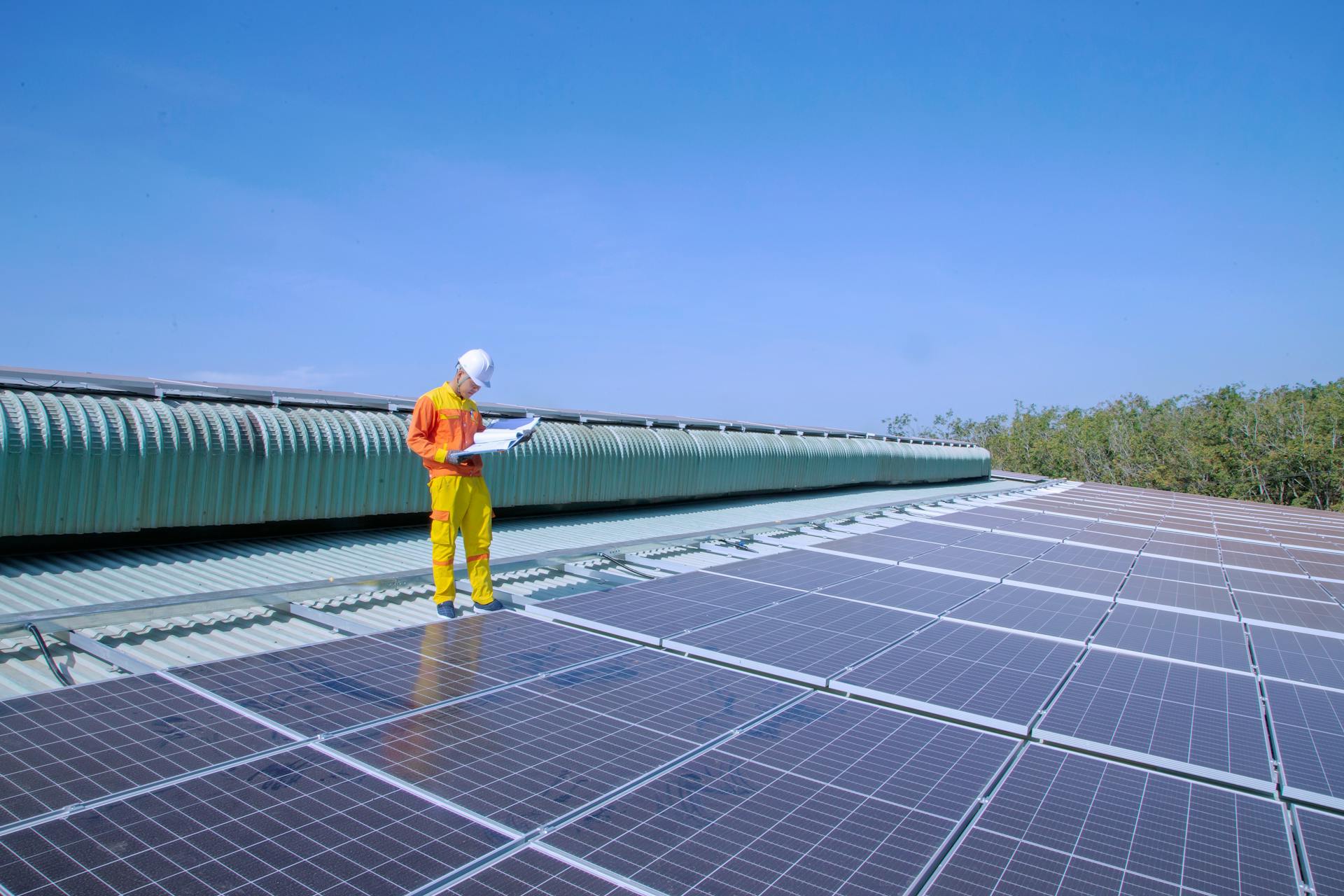
The hardest part of partner impact reporting is the shared project. Say three platforms send money through the same impact provider into one 4 MW solar project, and each tells its customers it funded 4 MW. Customers now hear about 12 MW from a single 4 MW project, and each report can look accurate on its own.
The GHG Protocol leaves this open. Its standard for project accounting says it "intentionally does not address" ownership of GHG reductions.
The methods that do exist come from finance: the ICMA handbook on green bond impact reporting and the PCAF standard banks use for financed emissions. ICMA has issuers show a project's whole result next to their share of it, and PCAF gives a formula for working out that share.
Agree on the fields before you sign with an impact provider. Here's the schema we'd ask for.
The reporting schema: fields to require from your impact provider
Our guide to funding renewable energy from transactions lists the base fields any impact report needs, from the reporting period to the method. The fields below add what you need once several partners share a project. Ask for them per project, for every reporting period.
| Field | What it holds | Evidence behind it | When it changes |
|---|---|---|---|
| 1. Project ID | An ID that stays fixed, plus the legal owner and technology | The owner's registration, and a registry or EIA plant ID where one exists | Never |
| 2. Physical status | Planned, under construction or operating, with the date it changed | See the status table below | When it happens |
| 3. Energized date | The date the project first delivered power | Permission to operate or commercial operation document | Once |
| 4. Money status | Committed, disbursed or being repaid, and the amount still outstanding | Funding agreement, disbursement record, repayment schedule | When money moves |
| 5. Whole-project results | Total capacity (AC, and DC if quoted), generation for the period, avoided emissions | Meter or settlement statements, plus the grid factor and its source | Each period |
| 6. Total project financing | All equity and debt in the project | The project's financial statements | Yearly |
| 7. Provider's share | The provider's money as a share of total financing, and the method used | The funding agreement and the calculation | Yearly, at a fixed date |
| 8. Your share | Your money as a share of the provider's money in that project, and the method | The provider's record of what it received from you, by period | Yearly, at a fixed date |
| 9. Your results | Your share applied to capacity, generation and avoided emissions | Rows 5, 7 and 8 | Yearly |
| 10. Estimate flag | Whether each figure is metered, modeled or a pre-construction estimate | The method note | Each period |
| 11. Version | Report date, version number and what changed since the last one | Change log | Each release |
| 12. Restatements | Earlier figures that changed: old value, new value, date and reason | Change log and the corrected evidence | When it happens |
Rows 7 and 8 are what stop the double counting. Without them, your report can only repeat the whole project's numbers, and that's how one 4 MW project turns into 12 MW.
Project status: what each stage lets you report
Status decides which numbers can appear at all. A planned or under-construction project generates nothing, so its capacity goes in a pipeline line and its generation and avoided emissions are zero for the period.
If a provider shows a pre-construction estimate, it has to be labeled as one. ICMA's handbook has bond issuers report expected results this way, and it warns that "there is no guarantee that these results will ultimately materialise."
| Status | What you can report | Evidence to require |
|---|---|---|
| Planned | Capacity, in the pipeline line. No generation or avoided emissions | Signed funding agreement, site control and permits |
| Under construction | Capacity, in the pipeline line, with the expected energized date | The contractor's latest progress report and dated site photos |
| Operating | Built capacity, plus generation and avoided emissions from the energized date on | Permission to operate or commercial operation document, then meter or settlement statements |
To check those documents against public records, such as the EIA's monthly generator file, use our guide to verifying that a renewable-energy project is operational.
Money has a stage of its own. ICMA suggests showing the "project stage from a financing point of view (such as signed, disbursed, repaying)." A signed commitment hasn't paid for anything yet. A project can be operating while your money is still only promised, and your money can be spent while the project is still being built.
Allocating a shared project across funding partners
ICMA's answer to double counting is to show the whole project, then the share. It recommends a report that "clearly defines, for each project, the overall project impacts (including financing from all financiers)," and that totals across projects include "only the pro-rated share." Keep both in your report. The whole figure tells customers what got built, and the share tells them what their purchases paid for.
There are two layers of share. The provider funds part of the project, and your money is part of the provider's. Your share of the project is one multiplied by the other. Pick one of the three methods below, write it into the contract, and keep it from year to year.
By dollars
This is the default. It borrows PCAF's attribution factor, which banks use to assign each financier a share of a project's emissions: "the ratio between the institution's outstanding amount (numerator) and the total equity and debt of the financed project (denominator)." Here it's applied to generation and avoided emissions, twice: the provider's money over the project's total financing, then your money over the provider's.
By capacity
Sometimes a partner's money pays for a defined block, such as 200 kW of a 4,000 kW array. That partner's share is 200 out of 4,000, or 5% of the project's generation and avoided emissions. Take the block out first and split the rest by dollars, so the block isn't counted twice.
By period
Money arrives over time, and a project starts generating on one date. Period allocation matches them up: a year's generation goes to the money that was in the project that year, so a partner whose money arrives in July shares in the second half of the year only.
Repayment moves shares too. PCAF counts debt as "disbursed debt minus any repayments," so if a provider lent $1.0 million and $400,000 has come back by year-end, its numerator for that year is $600,000 (example figures). In PCAF's words, "as debt is repaid more and more of the emissions become attributable to the equity providers."
Ask your provider what happens to a project in your report once the money is repaid. ICMA's convention drops it "after the underlying loans have been repaid." PCAF's approach keeps it in at a shrinking share. Either can work, as long as it's written down and the same every year.
Worked example: one 4 MW project, three partners
The numbers here are illustrative, made up to show the arithmetic. A 4 MW solar project is operating and generated 5,600 MWh this year. At an illustrative grid factor of 0.70 metric tons of CO2 per MWh, that's 3,920 metric tons avoided. The project's total financing is $5.0 million, and the impact provider put in $1.0 million of it, pooled from three partners.
| Funder | Money in | Share of project | Capacity | Generation | Avoided (metric tons CO2) |
|---|---|---|---|---|---|
| Whole project | $5,000,000 | 100% | 4.00 MW | 5,600 MWh | 3,920 |
| Impact provider | $1,000,000 | 20% | 0.80 MW | 1,120 MWh | 784 |
| Partner A | $500,000 | 10% | 0.40 MW | 560 MWh | 392 |
| Partner B | $300,000 | 6% | 0.24 MW | 336 MWh | 235 |
| Partner C | $200,000 | 4% | 0.16 MW | 224 MWh | 157 |
The three partner rows add up to the provider's row. Run that check on any report you get. If each partner had reported the whole project instead, the three reports would claim 12 MW and 11,760 metric tons between them.
Partner A's line for its customers can then carry both numbers: "Your purchases funded 0.4 MW of a 4 MW solar project that's now operating" (example figures). Before a line like that goes live, run it through our climate-impact claim checklist.
How often each field should update
None of these three standards covers partner reports, so borrow the finance rule for the totals. ICMA asks for impact reporting "at least on an annual basis," and PCAF says to disclose "at least annually and at a fixed point in time in line with the financial accounting cycle."
The GHG Protocol's project standard asks for a yearly report "to confirm that the GHG project has been implemented as planned and to update or revise any assumptions."
Below the totals, update each field when its evidence changes. A status change should reach you when it happens, with the document attached. Generation can update as often as meter data arrives, monthly or quarterly. Shares and avoided emissions work best fixed once a year on a set date, so a partner who joins in March doesn't change last year's numbers.
Restatements: when last year's number changes
Some figures will change after you've published them. Modeled generation gets replaced by meter data, a grid factor is revised, a project is delayed or dropped, a capacity figure turns out to be DC rather than AC, or refunds lower what a partner contributed.
PCAF requires financial institutions to set a recalculation policy and to "establish and disclose the significance threshold that triggers base year emissions recalculations." Ask your provider for the same in writing: the threshold, who decides, and how quickly you'll hear.
Each restatement should show the old value, the new value, the date and the reason, and the report as first published should stay available. If one of your customers quoted last year's figure, they need to see what changed and why.
How Dyme reports today, and what it doesn't show
Our impact results page reports portfolio totals: 5.5 MW of solar built and operating, with 20 MW more in the pipeline, as two separate numbers. It reports 7,807 MWh of clean electricity and 5,910 metric tons of CO2 avoided a year, and it names the grid factor, 0.757 metric tons per MWh from version 20.0 of the Central Electricity Authority's database. The working is in how we calculate Dyme's renewable energy impact.
Against the schema above, there are gaps. The 5.5 MW is the full size of the projects we helped fund, so it's a whole-project figure with no share row next to it. The page has no per-project status table, no per-partner allocation and no reporting period for the generation and CO2 figures, and it doesn't say whether the generation figure is metered or modeled. Our impact figures also aren't independently audited.
You can request project documents from us, including permission to operate and meter data. We don't use renewable energy certificates; we fund new solar directly. Our money in projects is paid back and goes into new solar, so the repayment question above applies to us as well.
The emissions estimate a member sees when booking a hotel is a different number. It uses grid emissions data as a proxy for the hotel's electricity use, and it belongs on its own line, apart from avoided emissions.
FAQ: partner impact reporting
What should a partner impact report include?+
For each project: its status with the evidence and date, the whole project's capacity, generation and avoided emissions, the provider's share of the project's financing, your share of the provider's money, and the numbers that result. Add a flag saying whether each figure is metered, modeled or a pre-construction estimate, plus a change log for restatements.
How do you avoid double counting when several partners fund the same project?+
Report the whole project and each partner's pro-rated share side by side, and check that the partner shares add up to the provider's share and no more. Agree on the method (by dollars, by a defined block of capacity, or by period) in the contract, and keep it the same each year.
Can a partner report avoided emissions from a project that isn't built yet?+
Not as a result. A planned or under-construction project generates nothing, so its capacity goes in a pipeline line and its avoided emissions are zero for the period. A pre-construction estimate can appear if it's labeled as one. ICMA's handbook notes there is "no guarantee that these results will ultimately materialise."
Can we subtract avoided emissions from our own carbon footprint?+
Keep them on a separate line. PCAF, the standard banks use for financed emissions, says reporting on avoided emissions "shall always be done separately" from a financial institution's scope 1, 2 and 3 inventories. Your auditor or sustainability adviser can confirm how your own reporting framework treats them.
How often should an impact provider update partner reports?+
Status changes as they happen, generation as often as meter data arrives, and shares and avoided emissions once a year on a fixed date. ICMA and PCAF both ask for the totals at least once a year.